THE LEGACY OF "EDOARDO AMALDI" IN SCIENCE & SOCIETY - CONFERENCE
  
   EDOARDO AMALDI  
HOME
ORGANIZING COMMITTEE
CONFERENCE SPEAKERS
SCIENTIFIC PROGRAM
TIMETABLE SCHEDULE & SLIDES
PATRONAGE and SPONSORSHIP
COMPETITION "E. AMALDI"
CONFERENCE POSTER
BROCHURE
PHOTO GALLERY
CONTACT US


A short curriculum vitae by E. Amaldi himself

EDOARDO AMALDI, born in Carpaneto (Piacenza) the 5 September 1908, is son of Luisa Basini and Ugo Amaldi, who has been professor of mathematics (analysis and rational mechanics) at the Universities of Cagliari, Modena, Padua and Rome. E.A. attended the primary schools in Modena and the secondary schools in Padova, except for the last year since his family had moved to Rome. The successive year he entered the faculty of engineering of the University of Rome, in spite of the fact that, since a few years, he had been strongly attracted by the study of physics.
Towards the end of the second academic year, following an appeal made at the end of the lecture by Orso Mario Corbino, professor of experimental physics and Director of the Institute of Physics, he passed to the study of physics. Corbino had pointed out that with the recent appointment of Enrico Fermi to the chair of Theoretical Physics new perspectives were open to young people ready to engage themselves in a thorrow study of modern physics.

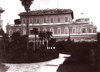
The Physics Institute of Via Panisperna

Entering the Institute of Physics Amaldi found himself under the supervision of Enrico Fermi and Franco Rasetti, who had followed Fermi from Florence to Rome and had been appointed "first assistant" (aiuto) of Corbino. The experimental ability of Rasetti provided an extraordinary completion to Fermi's teaching that, in those years, was mainly in the field of theoretical physics.

Passing from the study of engineering to that of physics, Amaldi became school-mate of Emilio Segrè, who, however, was about two years older. They had become acquainted shortly before, on occasion of a short alpine stay at the Gran Sasso d'Italia, and had immediately become good friends, also because Segrè, following an old inclination, had changed just a few months before from the School of Application in Engineering to Physics.

E.Amaldi attended the courses of many well known professors among which the following should be mentioned: Guido Castelnuovo, Tullio Levi-Civita, Vito Volterra, Franco Rasetti and Enrico Fermi.

He got his university degree (laurea) in July 1929 with a thesis on the Raman effect of benzene, carried on under the supervision of Rasetti. The same day got their degree also Ettore Majorana who had followed the example of Segrè about one year later, and Gabriello Giannini, who later became a well known industrialist in U.S.A.

After the military service, Amaldi, at the beginning of 1931, went to Leipzig with a fellowship of the Opera Alberoni of Piacenza, to work under the guidance of P.Debye,on the diffraction of X-ray from liquids.

He had, however, already before leaving for Leipzig, published a few papers in atomic and molecular spectroscopy, some of which were in collaboration with Segrè.Back to Italy, towards the end of 1931, he became assistant of O.M.Corbino and started to work again in spectroscopy.During the years 1932-34, in the frame of a new orientation of the whole Institute, he started to devote a large fraction of his time to the study of problems of nuclear physics, or better radioactivity according to the language of the time.

Thus he found himself to collaborate with E.Fermi, F.Rasetti, E.Segrè, O.D'Agostino, and, some time later, also B. Pontecorvo, to the researches on the neutrons carried on in Rome in the period 1934-38.
In the same period he completed his scientific training at the Cavendish Laboratory (summer 1934), Columbia University and the Department of Terrestrial Magnetism of the Carnegie Institution of Washington (summer 1936)
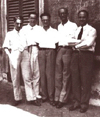
The picture was taken by B. Pontecorvo.

Il "Gruppo di Via Panisperna" [From left] O.D'Agostino, E.Segrè, E.Amaldi, F.Rasetti, E.Fermi (1934)


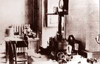
Some instruments used for neutrons research (1934-1938)

In 1937, he took part in the national competition for the chair of Experimental Physics of the University of Cagliari and was placed in the first line by the corresponding committee. But just in those months Corbino died prematurely and Amaldi was called to the chair of Experimental Physics of the University of Rome.

When in 1939 the group created by Corbino and Fermi, was dissolved as a consequence of the racial laws of the fascist government, Amaldi remained alone at the Institute of Physics of the University of Rome.

When Italy entered the Second World War (June 1940) E.Amaldi was called in the army and send to the front in North Africa. Six months later, on request of the Faculty of Sciences of the University of Rome, he was sent back to his teaching duty. After the end of the war he was brought partly by personal decisions partly by environmental circumstances, to devote a considerable part of his activity to try to maintain alive the scientific school that Fermi had created in Rome at the beginning of the 3Os and that had reached in a short time a high level of scientific production.

From 1949 to 1960 Amaldi was Director of the Institute of Physics of the University of Rome. In the period 1948-1954 he was Vice-President and in the three years 1957-1960, President of the International Union of Pure and Applied Physics (IUPAP).

From 1952 to 1954 Amaldi was Secretary General of the European Center for Nuclear Physics (CERN). In such a capacity he directed the design and initial construction of the Geneva Laboratories, of which he was Vice-Director from September 1954 to February 1955.

In 1952 he founded the Scuola di Perfezionamento in Fisica Nucleare of the University of Rome, of which he was Director from the origin to the academic year 1965-66.

From 1945 to 1952 he was nominated Director of the Centro di Fisica Nucleare of the Consiglio Nazionale delle Ricerche (CNR). In 1952 this Center was transformed into one of the Sections of the Istituto Nazionale di Fisica Nucleare (INFN), which was under his directorship until 1960. In that year he became President of INFN, a function that he maintained until the end of 1965.

From 1956 to 1960 he was Vice-President of the Comitato Nazionale per le Ricerche Nucleari (CNRN) and from 1960 to 1965 Member of the Commissione Direttiva of the Comitato Nazionale per l'Energia Nucleare (CNEN).

In 1958 and 1959 Amaldi was President of the Scientific and Technical Committee of Euratom, of which he was a Member for two more years.

In the three years 1958-60 he was President of the Scientific Policy Committee of CERN, of which he remained a Member until June 1975. He has been President of the Council of CERN in 1969-70.

In the period 1968-1978 he has been President of the Scientific Committee for Physics of the Solvay Foundation (Bruxelles) of which he is still a Member. He has been the Chairman of the Scientific Programme Committee of the European Space Agency (ESA) in 1980-81 and of the Space Science Advisory Committee of the same Agency in 1982-83.


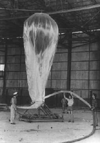
A sounding balloon used for cosmic rays research
(Cagliari Elmas airport - 1953)


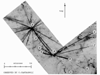
The first "antiproton" observed by E.Amaldi et al. in Rome (1960)

Starting from 1960 Amaldi has played a leading role in the study, preparation and beginning of the new program of accelerators of CERN, centered on the construction of the Intersecting Storage Rings (I.S.R.) and the 400 GeV protosynchrotron (SPS).

He is a Member of the Accademia Nazionale dei Lincei (1948) and of the Accademia Nazionale dei XL (1957), and of many other Italian and foreign academies. Among these one should recall: the Regia Societas Scientiarum Upsalensis (1957), the Academy of Science of USSR (1958), the American Philosophical Society of Philadelphia (1961), the National Academy of Sciences of USA (1962), the American Academy of Arts and Sciences of Boston (1962), the Royal Academy of Netherland (1963), the Academia Leopoldina (1964), the Royal Academy of Sciences of Spain (1966), the Royal Society of London (1968), and the Royal Academy of Sweden (1968). He is doctor honoris causa of the Universities of Algeri (1959), Glasgow (1972) and Oxford (1974) and has received the "Seal of the Sorbona" (1964).

In 1988 Amaldi has been appointed President of the Accademia Nazionale dei Lincei.

Among his researches in the field of atomic spectroscopy one should recall those, in collaboration with E.Segrè (1932-34), on the highly excited terms of alcalines which have brought, among others, to establish the influence of a foreign gas on the position of these terms: according to Fermi's theory of this new phenomenon the displacement of the spectral lines is due in part to the dielectric constant of the foreign gas, in part to the scattering cross section of electrons of extremely low velocity against the atoms of the foreign gas. These experiments initiated the study of what later were called "Rydberg states".

In the field of molecular spectroscopy the study of the rotational Raman effect of ammonia, made in collaboration with G.Placzek (1932-33), provides the first experimental

test of the corresponding selection rules derived from quantum mechanics for the symmetrical top rotator.

Most of the research activity of Amaldi in the 30s refers to nuclear physics, and in particular to the study of the interaction of neutrons with matter. This work was made, in great part, in collaboration with Fermi and others (1934-1937).

In this field he has contributed to the study of radioactivity produced by neutron bombardment, in particular to the discovery of many new radioactive bodies distributed along the whole Mendelejeff Table, from very light elements to thorium and uranium, to the discovery of the slowing down of neutrons and the study of the properties of slow neutrons.

Among these last researches one should recall: the discovery of the effect of the chemical bond of the atoms of the moderator on the elastic cross section of neutrons, the experimental identification of the disintegration process produced by slow neutrons in boron, the contribution in establishing the existence of resonances in the capture of neutrons by nuclei and the first determination of the width of the corresponding levels. He has also contributed to the clarification of the main features of the slowing down and diffusion of neutrons.

In the period 1939 to 1941 he worked on uranium fission with special regard to the increase of the fission cross section of U238 when the energy of the incident neutron is not far from 10 MeV or greater. The theory of this effect was given by Niels Bohr in a paper appeared in the Physical Review in 1940.

Later Amaldi worked on the interaction of fast neutrons with protons and deuterons, and between 1945-47 he provided the first experimental test of the so called optical theorem, consisting in a very general relationship between absorption and scattering of fast neutrons. This work involves the first clear experimental proof of the diffraction undergone by fast neutrons when scattered by nuclei.

Amaldi is then passed to work on cosmic rays (1947-1955). First he studied the interaction of fast muons with nuclei arriving at the conclusion that these particles do not have strong interaction up to energies of the order of 10 GeV. Later with the technique of nuclear emulsion he studied the decay of various strange particles in particular of the t-meson.

With the same technique has participated (1955-60) in a collaboration between the Universities of Rome and Berkeley (California) for investigating the annihilation of antiprotons.

Between 1961 and 1968 with a number of collaborators he carried out various experiments aiming to the detecting of the magnetic monopoles suggested on theoretical grounds by Dirac (1931). These researches that gave negative results, were followed by a few experiments carried out with the electrosynchrotron of the Laboratori Nazionali of Frascati on the electroproduction of pions. From the cross section of this process, measured near threshold, Amaldi's group deduced the axial form factor of the nucleon (1969-72). Later (1973-74) the same group of the University of Rome investigated, in collaboration with a group of the Brookhaven National Laboratory, the multigamma events produced in proton-proton collision at the ISR of CERN.

During the last few years with another group of researchers, Amaldi has started to develop cryogenic detectors of gravitational radiation.

Among his books and monographic articles the following can be mentioned:

"The production and slowing down of neutrons" pp.1-659 of Vol.38/2 of Handbuck der Physik, edited by S.Flügge, Springer Verlag, Berlin (1959).

"Pion Electroproduction: Electroproduction at Low Energy and Hadron Form Factors" (in collaboration with S.Fubini and G.Furlan) Vol. 83 'Springer Tracks in Modern Physics', Springer Verlag, Berlin, Heidelberg, New York (1979) p. 1-163.

"Search for Gravitational Waves" (in collaboration with G.Pizzella) p. 9-139 of Vol. 1 of 'Relativity, Quanta and Cosmogony', edited by F. de Finis, Johnson Reprint Corporation, New York (1979).

               e-mail: amaldi2008@roma1.infn.it

G.Bucci -